In brief
This 2026 guide compares ten Canberra suburbs for first home buyers and families, including Banks, Macgregor, Chisholm, Kaleen and Franklin. It uses September 2026 HtAG Analytics data on house prices, price growth and selling times alongside information on schools, transport and lifestyle to help you shortlist suburbs for your budget and needs. The guide also compares Canberra houses and units and covers ACT stamp duty concessions and local property checks before buying.
This is a shortlist of ten suburbs, not a ranking of every Canberra suburb. “Best” depends on your budget, household and preferred location. Market figures refer to September 2026, not live asking prices. Read the sources and comparison notes.
The best Canberra suburbs for first home buyers in 2026 are the established pockets where a 3-bedroom house still sits around $800,000 to $890,000, such as Banks, Macgregor, Calwell, Holt and Latham. For families wanting more space, Chisholm, Kaleen, Franklin, Watson and Hackett stand out for different reasons, from tight supply to room to negotiate.
Below is what the latest data says about each one, what has changed for first home buyers this year, and how to work out which suburb actually fits your budget and lifestyle.
Quick answer: the best Canberra suburbs in 2026
- Best value for first home buyers: Banks and Macgregor, with 3-bedroom houses around $805,000
- Best long-term growth under $900,000: Holt, averaging 7.1% a year over the past decade
- Best for families under $1 million: Chisholm, where 4-bedroom houses sit just under $1 million
- Best established family suburb: Kaleen, with homes selling in around 26 days
- Best for negotiating: Franklin, where homes typically sell around 6% below the first asking price
- Best inner north option: Watson, cheaper than Ainslie or Hackett with 6.6% average yearly growth
- Biggest change this year: eligible buyers now pay $0 stamp duty, with no income test or price cap
Where the Canberra market sits right now
Canberra houses have held up well while units have gone backwards. As of September 2026, the typical Canberra house is worth around $1.06 million, up 4.1% over the past 12 months. The typical unit is around $600,000, down 1.9% over the same period (HtAG Analytics).
The headline number hides a lot. Domain's June quarter report showed some suburbs jumping by double digits even as the city-wide median dipped for the quarter, and local agents noted more first home buyers heading south to Banks and the Woden Valley in search of value (Allhomes, August 2026).
In short, Canberra is a suburb-by-suburb market. Picking the right pocket matters more than trying to time the whole city.
The big 2026 change: $0 stamp duty for eligible home buyers
If you're buying your first home (or haven't owned property for a while), this is the most important thing to know this year.
For contracts signed from 1 July 2026, eligible buyers under the ACT Home Buyer Concession Scheme pay no stamp duty at all, with no income test and no property price cap (ACT Revenue Office). Before July, the full exemption stopped at $1,020,000 and household income had to be $250,000 or less.
To be eligible, broadly:
- every buyer must be an individual aged 18 or over
- no buyer (or their partner) can have owned any property, anywhere, in the past 5 years
- at least one buyer must move in within 12 months and live there for at least 12 months
That last point matters. If you don't meet the residence rule, full duty plus penalties can apply. Check your situation with the ACT Revenue Office or your conveyancer before you sign.
For a dual-income public service household, removing the income test is a big deal. Many couples who were previously locked out are now eligible, and the savings on a $900,000 home run into the tens of thousands.
Best Canberra suburbs for first home buyers
These five suburbs combine an entry price under $900,000 with solid long-term growth and steady buyer demand.
Swipe horizontally to compare all columns.
| Suburb | Estimated house value | Price change, last 12 months | Average yearly growth, last 10 years | Typical days to sell |
|---|---|---|---|---|
| Banks | $804,000 (3-bed) | +5.3% | 6.4% | 42 |
| Macgregor | $809,000 (3-bed) | +4.1% | 5.9% | 32 |
| Calwell | $835,000 (3-bed) | +4.9% | 5.9% | 38 |
| Holt | $844,000 (all houses) | +3.4% | 7.1% | 50 |
| Latham | $884,000 (all houses) | +5.0% | 5.9% | 49 |
Source: HtAG Analytics, September 2026. Figures are estimates of typical values, not valuations.
Banks
Banks is one of the strongest performers on this list, with house prices up 5.3% in the past year and 6.4% a year over the past decade. It's a quiet, leafy southern suburb at the edge of Tuggeranong, close to Lanyon Marketplace and the Murrumbidgee corridor. Very few homes are listed at any one time, so good ones don't hang around.
Best for: first home buyers who want a freestanding house and don't need to be near the city.
Macgregor
Macgregor homes are selling in around a month, usually at or very close to the asking price. That tells you demand is strong for this price point in Belconnen. It's close to Kippax and an easy run to the Belconnen town centre.
Best for: buyers who work in Belconnen or Bruce and want a solid starter house.
Calwell
Calwell owners tend to stay put, with a typical hold of around 10 years, and very little stock comes to market. Prices are up 4.9% over the year. It's well placed for Tuggeranong town centre and the Monaro Highway.
Best for: couples planning to stay long term and start a family.
Holt
Holt has the best long-run growth of any suburb in this guide, averaging 7.1% a year over the past decade. It's in west Belconnen, close to the new Ginninderry development, and still one of the more affordable suburbs to get into a house.
Best for: buyers prioritising long-term growth over location.
Latham
Latham sits next to Holt and has grown steadily, averaging 3.6% a year over the past three years when much of Canberra was flat. Typical days to sell are just under 50, which gives you a little more breathing room to inspect and negotiate.
Best for: first home buyers who want a less frantic buying experience.
Best Canberra suburbs for families
Families usually need four bedrooms, a decent yard and a good school nearby. These suburbs suit different budgets.
Swipe horizontally to compare all columns.
| Suburb | Estimated 4-bed house value | Price change, last 12 months | Average yearly growth, last 10 years | Typical days to sell |
|---|---|---|---|---|
| Chisholm | $995,000 | +5.2% | 6.1% | 28 |
| Kaleen | $1.13 million | +2.0% | 4.9% | 26 |
| Franklin | $1.23 million | +5.2% | 5.4% | 88 |
| Watson | $1.41 million | +4.5% | 6.6% | 79 |
| Hackett | $1.42 million (all houses) | +4.3% | 5.7% | 61 |
Source: HtAG Analytics, September 2026. Figures are estimates of typical values, not valuations.
Chisholm
You can still buy a 4-bedroom house in Chisholm for under $1 million. That's rare in Canberra now. Homes sell in about four weeks and owners hold for over 11 years on average, so supply is very tight. Expect competition.
Best for: growing families on a budget who want space in the south.
Kaleen
Kaleen is a long-established Belconnen family suburb with big blocks, mature trees and a strong local community. Prices have been fairly flat for three years, but homes still sell quickly. For buyers, that combination can mean fair value in a suburb people rarely leave.
Best for: families wanting an established suburb close to the University of Canberra and Bruce.
Franklin
Franklin is on the Gungahlin light rail corridor, with newer homes and easy access to the Gungahlin town centre. Homes are taking close to 90 days to sell and typically go for around 6% below the first asking price. For a prepared buyer, that's real room to negotiate.
Best for: families who want a newer home and value public transport.
Watson
Watson gives you inner north access at a lower price than Ainslie or Hackett, with 6.6% average yearly growth over the past decade. It's close to Dickson's shops and restaurants and the Mount Majura walking trails. Homes are taking a while to sell, which can work in a buyer's favour.
Best for: families who want to be within 10 minutes of the city.
Hackett
Hackett has been one of the more consistent performers in the inner north, averaging 4.4% a year over the past five years. It backs onto Mount Ainslie and Mount Majura nature reserves and has a small, popular local shopping centre.
Best for: families with a higher budget who want character and nature on their doorstep.
How quickly homes are selling
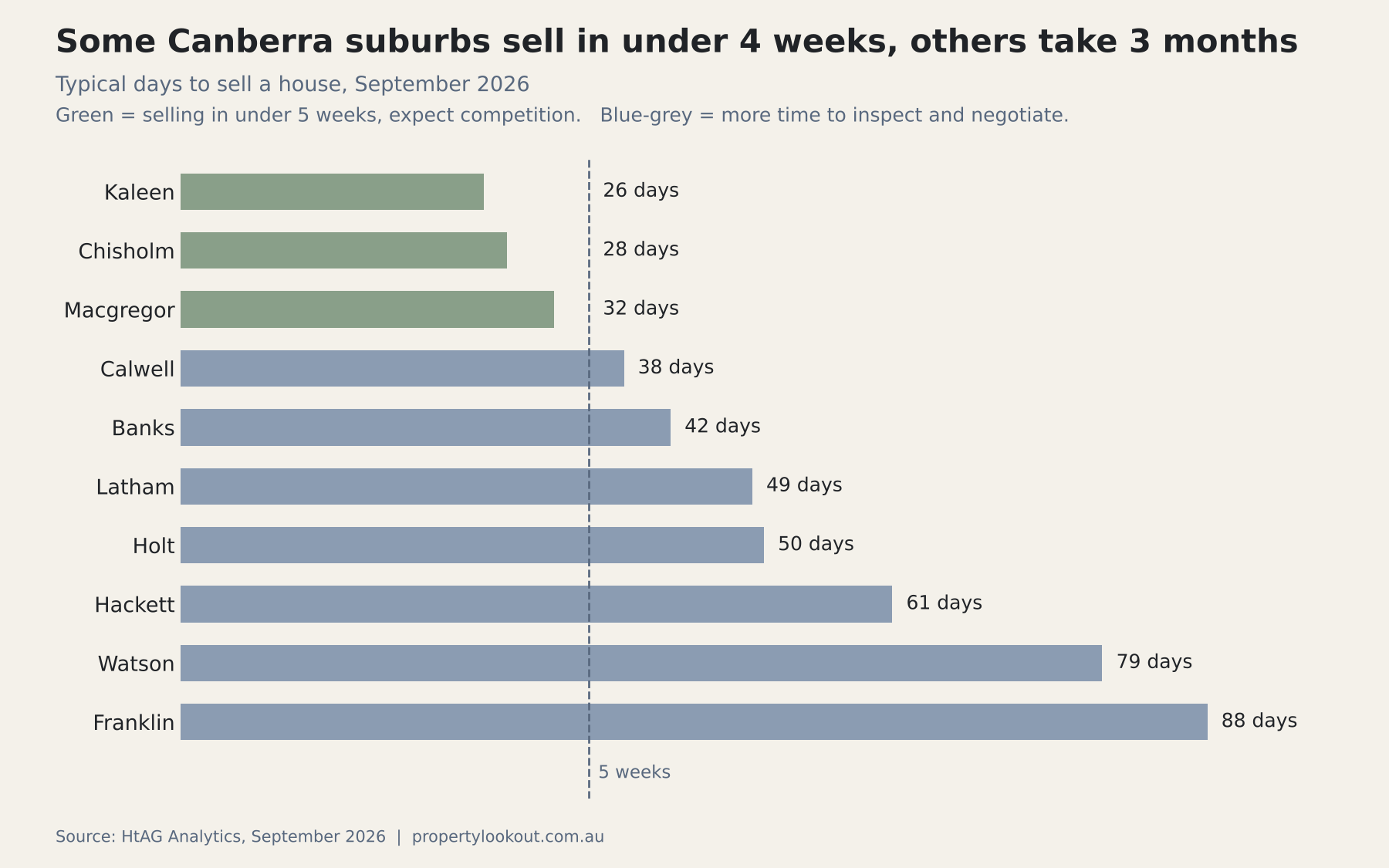
How fast a suburb sells tells you how much bargaining power you'll have. In the quicker suburbs you need finance ready and a clear limit before you inspect. In the slower ones, you can take your time and negotiate harder.
Canberra suburbs by budget
If your budget is set, start here. Values are typical house values across all sizes, so a 3-bedroom will usually sit below these and a 4-bedroom above.
Swipe horizontally to compare all columns.
| Budget | Suburbs worth a look |
|---|---|
| Under $900,000 | Charnwood, Richardson, Holt, Isabella Plains, Latham, Macgregor, Higgins, Scullin |
| $900,000 to $1 million | Chisholm, Dunlop, Gordon, Theodore, Conder, Banks, Ngunnawal, Florey, Calwell, Kambah, Amaroo |
| $1 million to $1.25 million | Kaleen, Fisher, Weston, Crace, Harrison, Franklin, Duffy, Downer, Lyons, Cook |
| $1.25 million to $1.5 million | Watson, Nicholls, Wright, Denman Prospect, Farrer, Hackett, Chapman, Curtin, Ainslie |
Source: HtAG Analytics, September 2026.
Suburbs to watch
Two more affordable suburbs posted big jumps in Domain's June quarter figures. Florey's median house price rose 23.4% to $975,000, and Strathnairn's rose 16.5% to $955,000 (Allhomes, August 2026).
Be careful reading too much into a single quarter. In smaller suburbs, a handful of sales can swing the median a long way. Florey's longer-term numbers are more modest, so look at the 5 and 10-year picture before you chase a hot suburb.
Houses vs units in Canberra: which is better in 2026?
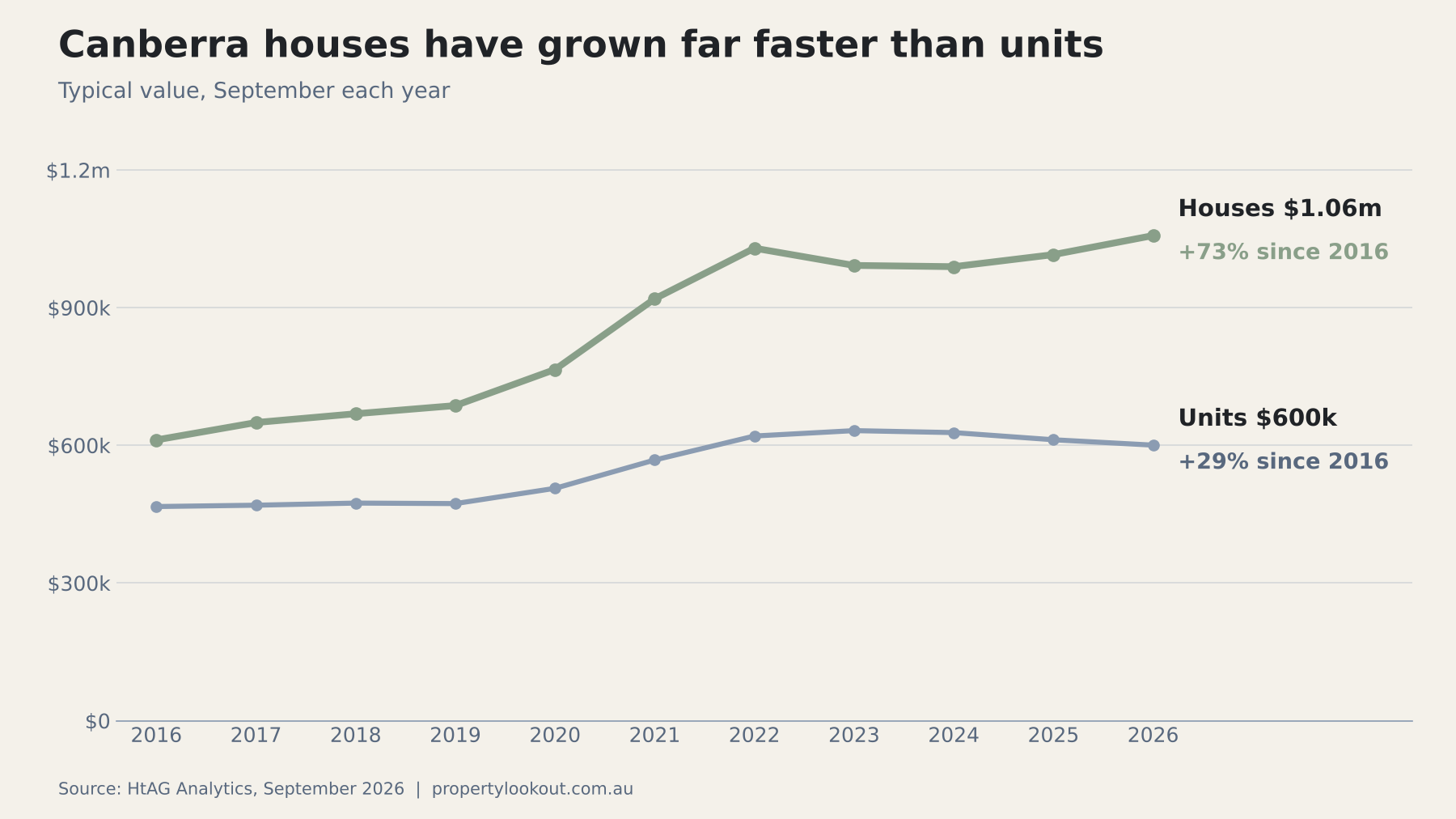
For most first home buyers and families, the data favours houses right now. Over the past 12 months, Canberra houses are up 4.1% while units are down 1.9%. Over 10 years, houses have averaged 5.6% growth a year compared with 2.6% for units (HtAG Analytics).
That doesn't make every unit a bad buy. A well-located townhouse or a unit in a small, owner-occupied block can still be a smart first step, especially if it gets you into a suburb you couldn't afford otherwise. The key is avoiding areas with lots of new apartment supply, where prices tend to struggle.
One upside of the stamp duty change: it applies to all residential property, including units and vacant land, so you aren't pushed towards one type over another.
How to choose the right suburb for you
The numbers above are a starting point, not a decision. Before you commit to a suburb, work through these questions:
- What's your real budget? Your borrowing capacity, not the bank's maximum. Talk to a mortgage broker early.
- Where do you work, and how will you get there? A cheaper suburb can cost you an hour a day in traffic.
- Which school catchment do you need? Check the ACT Education Directorate's priority enrolment areas for each address, not just the suburb.
- House or townhouse? In some suburbs, a townhouse gets you into a better location for the same money.
- What will you need in 5 to 10 years? Buying slightly bigger now can save the cost of selling and buying again.
Canberra-specific checks before you buy
Buying in the ACT works a little differently to other states. These are the checks I see first home buyers miss most often.
- Read the building and pest reports, then get your own advice. ACT sellers must include these reports with the contract. They're a great starting point, but they were ordered by the seller, so have someone you trust walk you through them.
- Check the energy efficiency rating (EER). Every Canberra home advertised for sale needs an EER. A low rating means higher heating bills through a Canberra winter, so factor that into what you'll pay.
- Understand you're buying a lease. ACT land is leasehold, usually on a 99-year Crown lease. In practice it works much like freehold, but the lease sets out what the land can be used for, which matters if you plan to extend or add a second dwelling.
- Look for unapproved work. Decks, carports, sheds and converted garages built without approval can cause problems at settlement or when you sell later. Your conveyancer can check the building file.
- Check the loose-fill asbestos register. Older Canberra homes were affected by Mr Fluffy insulation. Affected properties are listed on the ACT Government's Affected Residential Premises Register, and the contract should disclose it, but it's worth checking the address yourself.
- Confirm your school catchment by address. Priority enrolment areas don't always follow suburb boundaries. Check the exact address with the ACT Education Directorate.
Do you need a buyers agent in Canberra?
You don't have to use a buyers agent, and plenty of people buy well on their own. But when good homes in Chisholm or Macgregor are selling in under five weeks, it helps to have someone in your corner who knows the market street by street, hears about homes before they're advertised, and handles the negotiation for you.
That's what I do. I'm Thad, and I run Property Lookout. I only work for buyers, and you deal with me directly from our first chat right through to settlement.
If you're still working out whether you're ready to buy, or which suburb fits your budget, start with my free Buyer Readiness Assessment. It only takes a few minutes and gives you a clear picture of where you stand and what to sort out next.
Frequently asked questions
What is the most affordable suburb in Canberra to buy a house?
Among established family suburbs, Charnwood is one of the most affordable, with typical house values around $754,000 (HtAG Analytics, September 2026). Suburbs like Banks, Macgregor and Ngunnawal offer 3-bedroom houses in the low $800,000s.
Do first home buyers pay stamp duty in the ACT?
From 1 July 2026, eligible buyers under the Home Buyer Concession Scheme pay no stamp duty, with no income test and no price cap. You must not have owned property in the past 5 years and must live in the home for at least 12 months.
Are Canberra house prices going up in 2026?
Canberra houses are up around 4.1% over the 12 months to September 2026, while units are down about 1.9%. Growth varies widely by suburb, so look at local data rather than city-wide averages.
Is Gungahlin or Tuggeranong better for families?
Both suit families. Gungahlin offers newer homes and light rail, while Tuggeranong suburbs like Chisholm and Calwell tend to offer larger blocks and lower entry prices. It mostly comes down to where you work and your budget.
How much does a buyers agent cost in Canberra?
Fees vary. Some agents charge a percentage of the purchase price, others charge a fixed fee. Whoever you speak to, ask for the full fee in writing and exactly what's included before you sign anything.
Which Canberra suburbs are selling the fastest?
Among the suburbs in this guide, Kaleen and Chisholm are selling quickest, with homes typically selling in around 26 to 28 days. Macgregor is close behind at around 32 days (HtAG Analytics, September 2026).
Can I use the stamp duty concession on a unit or vacant land?
Yes. The Home Buyer Concession Scheme covers all residential property in the ACT, including new homes, established homes, units and vacant residential land, as long as you meet the eligibility rules.
What is the best Canberra suburb for young families?
It depends on budget. Chisholm offers 4-bedroom homes under $1 million in the south, Kaleen suits families wanting an established Belconnen suburb, and Franklin suits those who want a newer home near light rail.
Should I buy now or wait in Canberra?
Nobody can reliably time the market. With house prices rising moderately and the stamp duty change now in place, many buyers are deciding the right time is when their finances and plans are ready. That's exactly what the Buyer Readiness Assessment helps you work out.
This article is general information only and isn't financial, legal or tax advice. Property values are estimates and can change. Check your eligibility for any concession with the ACT Revenue Office and speak to a qualified professional about your circumstances.
Sources and how to use this comparison
- Market figures: the tables and graphs reproduce the September 2026 figures attributed to HtAG Analytics in this article. The underlying historical export has not been independently checked for this guide. These estimates are not valuations or forecasts.
- Compare like with like: bedroom-specific house estimates in the suburb comparisons differ from typical values across all house sizes in the budget overview. Historical growth and selling times do not guarantee a future result.
- Stamp duty: the ACT Revenue Office’s Home Buyer Concession Scheme guidance confirms the income threshold and property value limit were removed from 1 July 2026. Age, prior ownership and residence requirements still apply, with limited exemptions. Earlier income thresholds also varied with dependent children. Checked 13 October 2026.
- Schools: use the ACT Government’s Priority Enrolment Area guidance to check the exact address rather than assuming a suburb guarantees entry to a particular school.
Related Canberra buying guides
Check the current rules before you buy
Market figures and policy references reflect the article's publication period. For current buying costs, lending guidance and concession eligibility, consult these primary resources and your qualified adviser. These resources are not a verification of every figure in this article.
- ASIC Moneysmart: buying a house
- ACT Revenue Office: buying a new home
- ACT Home Buyer Concession Scheme
Continue with buyer's agent fees and services, first home buyer support or more Canberra property guides.