In brief
Canberra house and unit markets are moving differently in the October 2026 update. Compare property type, suburb, supply, rents and selling times rather than relying on a single city-wide headline. Buyers should also check their current borrowing capacity and the different purchase costs in the ACT and NSW.
Four interest rate rises this year. Tax changes aimed squarely at investors. Headlines about falling prices interstate. It's no wonder so many Canberra buyers and owners are asking the same question: is the property market about to crash?
The data says no, at least not across the board. What's actually happening depends heavily on what you're buying and where.
- Houses are at a record high. The typical Canberra house is worth $1,057,210, up 4.1% over the year and above its 2022 peak. But prices have barely moved since May.
- Units are falling, slowly. The typical unit is worth $600,479, down about 2% over the year and 5% below its 2023 peak.
- Suburbs are moving in different directions. Houses in Chisholm, Kambah and Banks are up close to 6%. Crace is down 3%, and Ainslie and Downer are lower than they were three years ago.
So there isn't one Canberra market right now. There are dozens, and a crash headline doesn't tell you much about the suburb or property type you're actually looking at.
In this update I break down where the Canberra property market is at as of October 2026, which suburbs are leading and lagging, what's happening with units and rents, and whether buying just over the border in Queanbeyan, Googong or Yass still stacks up.
Canberra property market at a glance
| Measure | Houses | Units |
|---|---|---|
| Typical price (September 2026) | $1,057,210 | $600,479 |
| Change over 12 months | +4.1% | -1.9% |
| Change since May 2026 | +0.1% | -0.7% |
| Compared with previous peak | 2.4% above July 2022 high | 5.0% below August 2023 high |
| Typical weekly rent | $692 | $577 |
| Gross rental yield | 3.4% | 5.0% |
| Typical days to sell | 30 days | 46 days |
| Sales over the past year | 6,421 | 4,815 |
The short version: houses have had a solid year but have flatlined for four months, while units have been drifting lower for three years. Buyers now have more time and more room to negotiate than they've had in a while.
Data covers the ACT, sourced from HTAG Analytics. Prices are HTAG's typical price, a measure designed to smooth out the swings you get with simple medians.
Canberra house prices vs unit prices since 2021
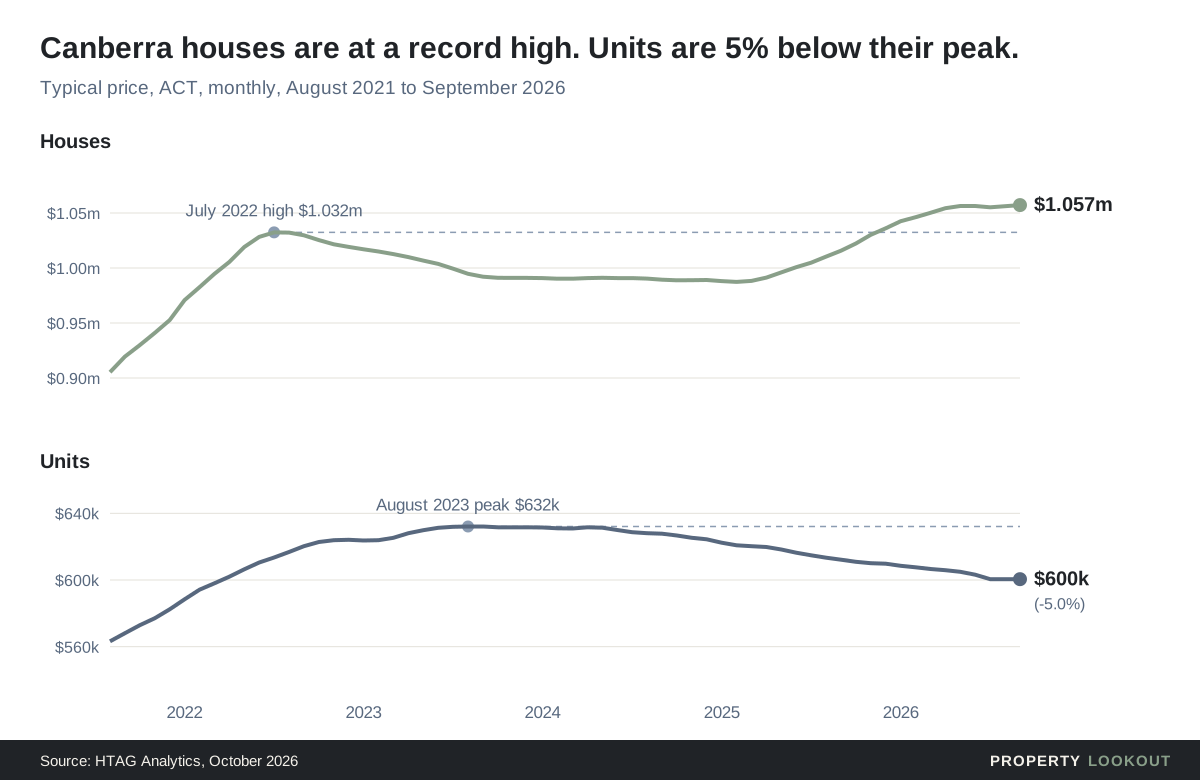
Houses dipped through 2023 and 2024, recovered strongly through 2025 and passed their 2022 high at the end of 2025. The line has gone flat since May. Units peaked in August 2023 and have edged lower almost every month since.
Why Canberra's market has stalled
Canberra house prices climbed steadily from early 2025 through to May 2026. Since then they've gone sideways. Three things explain the change.
1. Interest rates are back on the way up
The Reserve Bank lifted the cash rate to 4.60% on 29 September 2026. That's the fourth rise this year, after February, March and May, and it takes the cash rate to its highest level since 2011. The RBA has also made it clear it's prepared to go again if inflation doesn't ease. The next decision is on 3 November.
Every rise cuts what buyers can borrow. For a typical Canberra couple, that's often the difference between comfortably affording a family home and falling just short.
2. The investor tax changes
The May Federal Budget changed the rules for property investors. From 1 July 2027, negative gearing on established homes bought after 12 May 2026 is limited, and the 50% capital gains discount is being replaced with indexation and a 30% minimum tax on gains. New builds keep the old treatment.
The result has been fewer investors bidding on established homes. That takes pressure off prices, particularly in the unit market and in suburbs that have traditionally attracted a lot of investors.
3. Confidence has taken a hit
Higher living costs, rising rates and a fair amount of uncertainty mean many people who could buy are choosing to wait and see. Fewer active buyers means less competition and less urgency.
The upside for buyers
A flat market isn't a bad market. It's one where buyers set more of the terms. Vendors who need to sell are becoming more realistic, homes are taking longer to sell and there's more time to do your due diligence properly instead of making a rushed decision on auction day.
Supply and demand: who has the upper hand
Prices only tell half the story. How quickly homes sell and how much stock is available tell you who has the upper hand right now.
| Measure | A year ago (Sep 2025) | Now (Sep 2026) | What it means |
|---|---|---|---|
| Days to sell, houses | 23 | 30 | Houses are taking about a week longer to sell |
| Days to sell, units | 45 | 46 | Units have been slow to sell for a while |
| Months of house stock | 1.3 | 1.8 | More choice, but still tight overall |
| Months of unit stock | 2.6 | 2.6 | Steady, with no shortage of units |
Houses are still in short supply. Even after the slowdown, there's less than two months' worth of houses for sale at the current pace of sales. That's a tight market by any measure, and it's a big reason house prices haven't fallen despite four rate rises. Canberra owners also tend to hold on to their homes for close to 10 years, which keeps a lid on how many come up for sale.
Units are a different story. About 2,600 new units are approved for construction across the ACT each year, compared with roughly 800 houses. That's a steady pipeline of new apartments competing with existing ones, which helps explain why unit prices have struggled.
Renters still have little choice. Canberra's rental vacancy rate sits at around 1.5%. That's a tight rental market, which supports rents and keeps investors' properties tenanted.
Report from the ground: auctions, sales and buyer activity
Prices are a lagging signal. The best read on how buyers are feeling comes from what's happening around them: how many homes are selling, how auctions are going and how much interest is out there.
| Measure | A year ago | Now | Change |
|---|---|---|---|
| Houses sold, June to August | 1,523 | 1,029 | -32% |
| Units sold, June to August | 1,385 | 706 | -49% |
| House auction clearance rate (August) | 76.9% | 50.3% | down 27 points |
| Buyer online search activity | Above average | Above average | No change |
Recent sales counts can rise a little as late settlements are recorded.
Fewer sales, not fewer buyers. About a third fewer houses changed hands over winter than a year earlier, and unit sales roughly halved. Yet online search activity from Canberra buyers is still running above average and hasn't dropped all year. People are still looking. They're just taking longer to commit.
Auctions are the pressure point. Only half of Canberra house auctions cleared in August, down from more than three in four a year ago. When a buyer pool is cautious, auctions are where it shows first.
Top performing Canberra suburbs for houses
Tuggeranong is the standout. Four of the seven best performing suburbs over the past year are in the south, where a solid family home still sits just under $1 million.
| Suburb | Region | Typical house price | 12-month change | 5-year change | Days to sell |
|---|---|---|---|---|---|
| Denman Prospect | Molonglo Valley | $1,303,986 | +10.9% | +69.0% | 42 |
| Chisholm | Tuggeranong | $925,650 | +5.9% | +14.7% | 28 |
| Kambah | Tuggeranong | $971,270 | +5.8% | +16.7% | 27 |
| Banks | Tuggeranong | $946,814 | +5.7% | +23.6% | 42 |
| Wanniassa | Tuggeranong | $952,683 | +5.7% | +13.4% | 34 |
| Dunlop | Belconnen | $931,927 | +5.6% | +20.4% | 43 |
| Latham | Belconnen | $882,533 | +5.4% | +16.6% | 49 |
12 months to the end of August 2026. Only suburbs where HTAG rates the data as high confidence are included.
Why Tuggeranong is leading
All four Tuggeranong suburbs on this list have a typical house price between $925,000 and $975,000. That's the bracket where most Canberra families can still borrow at today's rates, so it's where competition has held up best. Their five-year growth has been modest, between 13% and 24%, which suggests they haven't run ahead of themselves either.
Kambah is worth calling out. It's Canberra's biggest suburb, with more than 200 house sales a year, and homes there are selling in under four weeks. That's strong, consistent demand, not a few lucky sales.
Denman Prospect: strong, with a caveat
Denman Prospect tops the list with growth of nearly 11%. It's a young suburb in the Molonglo Valley, so part of that rise reflects newer, larger homes being completed and sold. It's also worth knowing that its rental vacancy rate is around 5%, much higher than the Canberra average. It suits owner-occupiers well. Investors should look closely at the rental numbers first.
Belconnen's west is steady
Dunlop and Latham, both in Belconnen, round out the list. Both offer established family homes under $950,000 and have grown steadily over five years. They're the kind of suburbs that rarely make headlines but quietly do the job.
The slowest Canberra suburbs for houses
Only one established Canberra suburb has actually gone backwards over the past year. The rest of this list are laggards rather than losers: they've grown, just well below Canberra-wide house growth of around 4%, and several are lower than they were three years ago.
| Suburb | Region | Typical house price | 12-month change | 3-year change | Days to sell |
|---|---|---|---|---|---|
| Crace | Gungahlin | $1,057,141 | -3.0% | -2.4% | 38 |
| Ainslie | Inner North | $1,498,230 | +1.3% | -3.0% | 50 |
| Chifley | Woden Valley | $1,152,960 | +1.9% | -3.7% | 78 |
| Weston | Weston Creek | $1,062,668 | +2.2% | -0.7% | 48 |
| Casey | Gungahlin | $973,755 | +2.3% | +2.3% | 31 |
| Downer | Inner North | $1,184,579 | +2.4% | -1.0% | 41 |
| Kaleen | Belconnen | $1,024,947 | +2.4% | -0.9% | 26 |
12 months to the end of August 2026. High-confidence suburbs only.
Crace is the outlier
Crace is the only high-confidence Canberra suburb where house values have fallen over the year, down 3.0%. It has also slipped over three years. Homes there are still selling in a little over five weeks, so this looks like a price reset rather than a shortage of buyers.
The inner north has gone flat
Ainslie and Downer are two of Canberra's most loved inner north suburbs, but houses there have gone nowhere in three years. In Ainslie, the gap between asking price and sale price is wide, at around 9.6% on a typical sale. That tells you vendors have been listing high and buyers haven't been biting. Nearby Lyneham and Dickson are tracking similarly.
At around $1.2 million to $1.5 million, these suburbs need buyers with serious borrowing power. Each rate rise shrinks that pool.
Chifley is taking its time
Chifley houses are taking 78 days to sell, more than double the Canberra average. Sellers there need patience, and buyers have leverage.
A slow suburb isn't a bad suburb. Ainslie, Downer and Weston are all well located, established areas with long-term appeal. For a buyer with a long time frame, a flat market in a quality suburb is often where the best value is found.
Canberra units and rentals
Canberra units have been the weak link for three years. The typical unit is worth $600,479, down about 2% over the year and 5.0% below its August 2023 high.
The long-term gap between houses and units is even more striking. Over the past 10 years, the typical Canberra house has risen 73%. The typical unit has risen 29%.
| Over the past... | Houses | Units |
|---|---|---|
| 12 months | +4.1% | -1.9% |
| 3 years | +6.2% | -5.0% |
| 5 years | +16.7% | +6.6% |
| 10 years | +73.4% | +28.5% |
12-month change to September 2026. Longer-term figures to the end of August 2026.
Why the difference? A big part of it is supply. Canberra keeps approving thousands of new apartments each year, so there's always fresh stock competing with existing units. Units also change hands more often, with owners holding for around seven years on average versus closer to 10 for houses.
Rents are still rising
Rents tell a steadier story. The typical Canberra house rents for $692 a week, up 3.3% over the year. Units rent for $577 a week, up 3.2%. With rental vacancy at around 1.5%, good rentals are still being snapped up.
Because unit prices have slipped while rents have kept rising, unit yields have improved to about 5.0% gross. Houses return around 3.4%.
Should you buy a unit in Canberra?
Units can still work, especially for first home buyers and investors chasing yield. But be selective. Look for owner-occupier appeal, a well-run body corporate, a building that isn't surrounded by identical new stock and a floor plan people actually want to live in. Buying the right unit matters far more than buying a unit.
Buying just over the border: Queanbeyan, Googong, Yass and beyond
More Canberrans are looking across the border for a cheaper house, a bigger block or a country lifestyle within commuting distance. Here's how the main options compare.
| Town or suburb | Typical house price | 12-month change | 5-year change | Days to sell |
|---|---|---|---|---|
| Goulburn | $802,129 | +7.9% | +37.2% | 37 |
| Murrumbateman | $1,404,632 | +7.4% | +53.0% | 66 |
| Karabar | $924,946 | +7.2% | +23.2% | 96 |
| Googong | $1,189,169 | +6.2% | +68.4% | 60 |
| Yass | $823,745 | +3.6% | +25.2% | 64 |
| Bungendore | $1,038,768 | +1.9% | +25.5% | 45 |
| Jerrabomberra | $1,220,665 | +1.4% | +17.5% | 32 |
| Queanbeyan | $849,356 | +1.3% | +18.9% | 49 |
12 months to the end of August 2026. High-confidence locations only.
Queanbeyan and Karabar: cheaper, but not necessarily better growth
The typical Queanbeyan house costs about $850,000, more than $200,000 less than the typical Canberra house. That's a real saving. But growth over the past year has been just 1.3%, well behind Canberra. Houses across the wider Queanbeyan-Palerang council area are taking around 59 days to sell, almost twice as long as in Canberra, and selling about 3.6% below the asking price on average.
Karabar has grown faster, up 7.2%, but homes are taking more than three months to sell. If you're buying in Karabar, you have time on your side and room to negotiate.
Jerrabomberra and Googong: premium choices
Jerrabomberra and Googong are priced like good Canberra suburbs, at around $1.2 million. Jerrabomberra is the quickest-selling market on this list at 32 days, but growth has been modest. Googong has delivered remarkable growth over five years, up 68%, and is still rising. Investors should note that its rental vacancy rate is around 4%, so tenants have choice there.
Yass and Murrumbateman: country lifestyle, longer sales
Yass offers a typical house for around $824,000 and an easy run down the Barton Highway. Prices are up 3.6% over the year, and rents are rising faster, up nearly 9%. Homes take around nine weeks to sell, so buyers aren't under pressure.
Murrumbateman is the lifestyle play, with a typical house over $1.4 million and strong growth of 7.4% this year. Rental vacancy there is close to 5%, so it suits owner-occupiers far better than investors.
Goulburn: the best performer, further out
Goulburn has the strongest growth on this list, up 7.9% over the year and 37% over five years, with a typical house around $800,000. It's a longer drive, but for hybrid workers or investors looking at a regional centre with its own economy, it deserves a look.
Check the costs before you cross the border
NSW and the ACT have different rules for stamp duty, land tax and first home buyer support. Depending on your situation, that can swing your upfront and ongoing costs by thousands of dollars in either direction. Get advice on your own numbers before you commit.
What this means if you're buying in Canberra
For home buyers
This is a more balanced market than Canberra has had in a while. You have more time to inspect, compare and get building and pest reports done. Vendors who listed too high are adjusting, and auctions are passing in more often.
The catch is borrowing power. With another rate rise on the cards for November, make sure your pre-approval is current and your budget still works if repayments go up again. Don't stretch to the very top of what the bank will lend.
On timing
If you're waiting for prices to crash, the data doesn't point that way for houses. Stock is still tight, rental vacancy is low and owners tend to hold on to their homes for close to a decade. Prices may drift, but a big fall would need something to change sharply.
Nobody rings a bell at the bottom. A better question than "should I wait?" is "can I buy the right home at a fair price for my situation?" In a flat market, the answer is more often yes.
For investors
The rules have changed, so the old playbook doesn't automatically apply. Whether a new build or an established home makes more sense now depends on your income, your tax position and how long you plan to hold, so speak with your accountant before you commit.
In Canberra, units offer the better yield at around 5%, but houses have delivered far stronger long-term growth. Some markets outside the ACT are still growing faster. That's why I help Canberra investors buy right across Australia, not just at home.
Canberra property market FAQs
Are Canberra house prices going up or down?
Both, depending on the timeframe. The typical Canberra house is up 4.1% over the past 12 months and sits at a record high of $1,057,210. But prices have been flat since May 2026, so momentum has stalled.
Are Canberra unit prices falling?
Yes, slowly. The typical Canberra unit is worth $600,479, down about 2% over the year and 5% below its August 2023 peak. A steady pipeline of new apartments is part of the reason.
What are the best performing suburbs in Canberra right now?
Over the past year, Denman Prospect, Chisholm, Kambah, Banks, Wanniassa, Dunlop and Latham have led the way for houses. Tuggeranong suburbs priced just under $1 million have been the most consistent performers.
Is Queanbeyan cheaper than Canberra?
Yes. The typical Queanbeyan house costs about $850,000, roughly $200,000 less than the typical Canberra house. Growth has been slower over the past year, though, and homes take longer to sell. NSW stamp duty and land tax rules also differ from the ACT, so compare the full costs.
Is now a good time to buy property in Canberra?
For buyers with secure finance, a flat market can be a good time to buy. There's less competition, more time to do due diligence and more room to negotiate than during the boom. The right answer depends on your finances and how long you plan to stay.
Do I need a buyers agent in Canberra?
You don't need one, but a good buyers agent can save you time, help you avoid overpaying and give you access to off-market properties. In a market where some suburbs are rising and others are flat, knowing exactly what a property is worth matters more than ever.
Not sure where you stand?
Before you start booking inspections, take my free Buyer Readiness Assessment. It takes a few minutes and looks at your finance, research, negotiation and due diligence, then gives you clear next steps based on your answers.
Take the Buyer Readiness AssessmentFollow me for property insights: Instagram · Facebook · YouTube · LinkedIn
This article is general information only and isn't financial, tax or legal advice. Speak to a qualified professional about your circumstances.
Check the current rules before you buy
Market figures and policy references reflect the article's publication period. For current buying costs, lending guidance and concession eligibility, consult these primary resources and your qualified adviser. These resources are not a verification of every figure in this article.
- ASIC Moneysmart: buying a house
- ACT Revenue Office: buying a new home
- ACT Home Buyer Concession Scheme
Continue with buyer's agent fees and services, first home buyer support or more Canberra property guides.